Manufacturer as a technology partner
Remote reading of water, heat or gas meters today starts with a request that was uncommon few years ago: customers want data in a clearly documented format, integrated into their own environment, without one-off scripts and without compromising security. This shifts the role of the IoT device manufacturer.
The "box" with a radio module is no longer enough on its own. Without parsers, an open API, remote management and a documented firmware lifecycle, a project either fails to reach production or ends up in a grey zone that the internal development team has to maintain long-term.
The shift from hardware supplier to technology partner is not a marketing position. It is a practical consequence of how today's AMR (Automated Meter Reading) and AMI (Advanced Metering Infrastructure) projects look: hundreds to thousands of devices, several meter types, multiple communication layers (M-Bus, wM-Bus, LoRaWAN, NB-IoT) and an upstream system that expects a consistent payload across firmware versions.
Key takeaways
- The shift from hardware supplier to technology partner reflects how the lifecycle of an IoT project actually unfolds.
- Ready-made parsers, an open API, a containerised backend and remote firmware management shorten implementation and reduce the load on internal development.
- Compliance with frameworks such as the CRA stays on the manufacturer's side, not the customer's.
- For operators of AMR and AMI infrastructure, this translates into lower TCO, a stronger security posture and data that can be relied on for further decision-making.
What "complete solution" means today
A modern manufacturer of IoT converters typically delivers four layers that need to hold together:
- Hardware with tailored configuration: a converter prepared for a specific meter type, communication profile and network topology, not a universal device requiring manual pairing in the field.
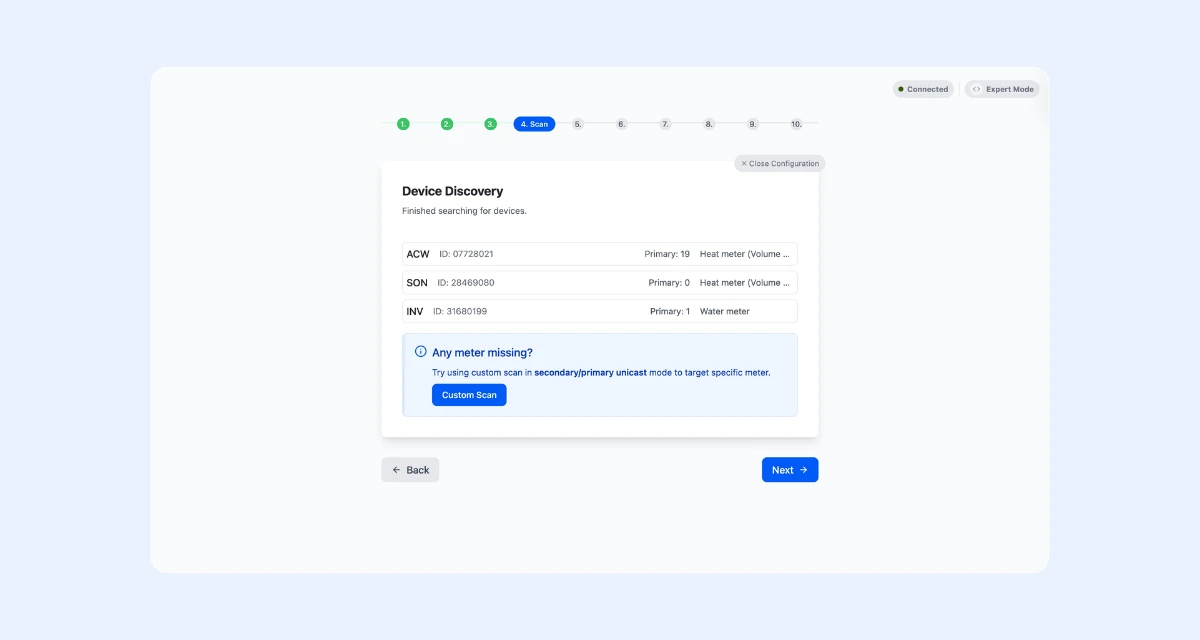
- Software tools and parsers: documented parsers for payload decoding, an open API for direct integration into the upstream system, a clear data contract version. One concrete example is the M-Bus installation tool Wizard from ACRIOS, which guides technicians through configuration step by step.
- Backend components for on-prem deployment: containerised applications (e.g. in Docker) that can run on the customer's own infrastructure without dependence on a third-party cloud.
- Remote management and firmware updates: OTA updates, remote diagnostics, controlled rollout of new versions across the fleet without physical interventions in the field.
When these layers exist side by side and remain mutually compatible, most of the "glue" work disappears. The customer's internal development team focuses on business logic and proprietary applications, not on tuning format conversions or writing one-off adapters between two systems that fail to understand each other.
Concrete benefits in project terms
- Shorter implementation: pre-built integrations, documented APIs and ready-made parsers shorten the path from "we want to measure" to "we have data in the system" from months to weeks.
- Lower load on internal development: customer teams handle their own application logic, not payload structures and decoding routines.
- Easy scaling: adding a new site or another few hundred devices is a repeatable process, not a new integration analysis.
- Long-term sustainability: the manufacturer maintains compatibility across firmware versions, addresses regulatory changes and provides security updates throughout the lifecycle.
Security is not an audit, it is a routine
The security layer in IoT is not a one-off certification. It is an ongoing process: device authentication, encrypted transmission, access control, signed firmware updates, controlled versioning and a documented recovery procedure after an outage. Without a stable data contract, the cost of measurement errors quickly compounds.
Under the CRA (Cyber Resilience Act, EU Regulation 2024/2847), this also stops being optional. Reporting obligations for manufacturers start applying from September 2026, with full application from December 2027. From that date, only products with digital elements that meet security requirements throughout the lifecycle may be placed on the European market, including mandatory reporting of actively exploited vulnerabilities within 24 hours and the provision of security updates for the expected lifetime of the product (in practice at least 5 years).
For operators of AMR and AMI infrastructure, the practical consequence is clear: choosing a manufacturer that does not actively address the CRA shifts the compliance risk onto the customer. A manufacturer acting as a partner handles this obligation as part of the product, from documentation through vulnerability management to support during incident reporting.
Practical scenarios from the field
In practice, the combination of product and services typically takes three forms:
Water utilities
Water utility operator deploys ACRIOS converters on existing water meters and within a few weeks has reliable remote reading. Supplied parsers and documented APIs cut integration into the upstream system from months to days.
District heating
A pilot at one district heating site is followed by rollout to other buildings using the same procedure, without a new integration phase. Converter configuration is repeatable, the data contract remains stable.
Gas utilities
Communication security and compliance with standards for sensitive meters, are critical here. A manufacturer-partner monitors the regulatory framework (CRA, EED), maintains compatibility across gas meter generations and delivers remote updates without on-site visits.
Openness as insurance against vendor lock-in
Concerns about technological dependence are legitimate. The answer lies in choosing a partner committed to openness: documented APIs, described data formats, support for open protocols, containerised backend components for self-hosted operation and transparent versioning. When these elements are in place, partnership does not mean loss of control. On the contrary, the customer keeps data in their own environment, in a format they can parse independently at any time.
Impact on TCO
From a total cost of ownership perspective, the equation is straightforward. Shorter implementation and fewer service interventions translate into immediate savings. Stable interfaces and a versioned data contract dampen hidden costs that otherwise arrive with every firmware or upstream system change. Remote management eliminates technician visits to individual converters. And because data flows in a predictable format, building proprietary analytics and decision logic on top of it becomes easier, whether in internal systems or in the cloud.
A manufacturer-partner does not pull control to themselves. They give the customer clean, documented data foundations and tools to work with according to their own rules.

Glossary of terms used
- AMR (Automated Meter Reading) and AMI (Advanced Metering Infrastructure): AMR enables remote collection of meter readings, while AMI adds broader infrastructure for two-way communication and device management
- Containerised application: an application packaged with its runtime dependencies so it can be deployed consistently across different computing environments
- CRA (Cyber Resilience Act): the EU regulation establishing cybersecurity requirements for products with digital elements and related obligations throughout their lifecycle, including vulnerability handling and security updates
- Data contract: an agreed and documented definition of the structure, format and meaning of data exchanged between systems
- On-prem deployment: running software on the customer's own infrastructure rather than in a third-party cloud
- Open API: a documented application programming interface that allows other systems to integrate with a solution and access its data or functions
- Over-the-air (OTA) update: a firmware or configuration update delivered to a device remotely over its communication network
- Parser: software that interprets incoming data and converts it into structured, usable values
- Payload: the application data carried in a message
- TCO (Total Cost of Ownership): the full cost of a solution over its lifetime, including purchase, installation, operation and maintenance
- Upstream system: a system that receives data from another component or system for further processing or integration
- Vendor lock-in: dependence on a single supplier or proprietary technology that makes switching to another solution difficult or costly
FAQs
It means the manufacturer delivers more than just devices. Alongside the hardware, they provide tailored configuration, documented APIs, ready-made parsers, containerised backend components and remote firmware management. This combination shortens implementation, reduces integration work on the customer's side and keeps the system maintainable across years of operation.
The CRA (EU Regulation 2024/2847) sets mandatory cybersecurity requirements for products with digital elements throughout their lifecycle. Reporting obligations apply from September 2026, full application from December 2027. Manufacturers must report actively exploited vulnerabilities within 24 hours and provide security updates for the expected lifetime of the product. Choosing a manufacturer that does not actively address the CRA shifts the compliance risk onto the customer.
Open APIs and documented parsers eliminate one-off integration scripts and shorten the time between deployment and usable data in the upstream system. They also protect against vendor lock-in, because the customer can parse data independently and integrate the solution into any environment. Stable data contracts across firmware versions further reduce hidden costs of future changes.
On-prem deployment means running backend applications directly on the customer's own infrastructure, typically as containerised services (e.g. in Docker), instead of relying on a third-party cloud. This approach gives the customer full control over data, simplifies compliance with internal security policies and removes dependence on external service availability.
A technology partner reduces TCO across multiple layers: shorter implementation cuts initial costs, remote management eliminates technician site visits, stable data contracts dampen hidden costs of system changes, and ongoing security updates and regulatory compliance prevent expensive retrofits. Customers also avoid the long-term cost of maintaining custom integration scripts and one-off workarounds.
Looking to modernise your AMR or AMI infrastructure with a manufacturer who delivers more than just hardware? Get in touch and we will walk you through configuration, integration and a path that keeps TCO and CRA compliance on our side, not yours.

Blog
ILI: what the EU leakage threshold measures

Pulsed water meter: All you need to know
LoRaWAN airtime: why radio conditions matter
Converter, bus, bridge, gateway: what's the difference?
What actually drains an IoT device battery
M-Bus parsing strategies for LoRaWAN and NB-IoT

How to best replace walk-by meter reading
Can your existing meters be retrofitted?

Battery life in IoT: beyond the datasheet number
Agile, Waterfall, or NRE? Choosing a development methodology
Developing adaptive IoT communication under the CRA
Focused supplier or large vendor? Depends on the project

Edge computing in IoT metering

Why a device without an antenna fails

CE certification for IoT: What RED DA changes
Water losses in utility networks: The hidden cost of leaks

Pressure monitoring in water networks: Early fault detection
M-Bus pressure sensor: Leak detection for water utilities
The cost of measurement data errors and how to prevent them

Smart Readiness Indicator (SRI): All you need to know
M-Bus installation tool Wizard from ACRIOS
Coulomb meter: Everything you need to know
ACR-EX in water utilities: remote reading of pulse water meters

ACRIOS and Quectel announce partnership

External or internal? How custom development works

Proven deployment of 10,000 wM-Bus converters for EED
Choosing a remote reading system for water utilities
Open data interfaces pay off for reporting and integration

15-minute vs daily meter readings frequency explained
Scripting in IoT: Flexibility, sustainability, and protection

Gas meter data to dashboard: ACR-EX meets Datacake
EPBD is coming: what BACS means for your building
When DTLS makes sense. Know before you deploy
Not your keys, not your hardware
868 MHz or 433 MHz? The right choice for your wM-Bus
Everything you need to know, documented. ACRIOS wiki.
End-to-end custom hardware and software development
How to collect energy data to support ISO 50001
Lowering IoT TCO through smart manufacturing
Reading Sensus meters with zero hardware changes

Why 15-minute data matters in district heating

Give me a tool that works. Not a manual.

5 most common myths about remote meter reading

Battery-powered vs wired: What really costs more?

Cyber Resilience Act and IoT hardware
Next-gen meter readings, no replacements needed

Modernising metering infrastructure

M-Bus to IoT integration explained
Understanding TCO: More than just hardware

NB-IoT technology: All you need to know

LoRaWAN: All you need to know

M-Bus, wM-Bus, and RS-485: A technology guide

LoRaWAN vs. NB-IoT: Which technology is right for you?
Smart metering: What it is and why it matters

IoT: Technology that saves time and money