Converter, bus, bridge, gateway: what's the difference?
Reading past the label on a datasheet
Search for a device that connects an existing meter to a remote reading system and the terminology quickly becomes confusing. Converter, bridge, gateway, repeater, concentrator and data logger appear across datasheets, sometimes for devices that look remarkably similar.
Some of these terms overlap. Others describe clearly different functions. The easiest way to tell them apart is not to rely on the product name, but to follow the data path instead.
Key takeaways
- Converter, bridge, gateway and repeater describe different functions. Some of these functions can overlap within one device, but the terms are not interchangeable.
- A bus, an interface and a protocol describe different aspects of communication, which is why terms such as M-Bus, RS-485 and Modbus should not be treated as synonyms.
- One device can have several technically valid descriptions at the same time, for example acting as an M-Bus master towards connected meters, as a converter towards another network, and also performing a data-logging function.
- A repeater is designed to extend existing communication rather than translate it into another protocol.
- A converter makes one signal, interface, protocol or communication method usable in another environment, which makes converters particularly relevant to retrofit projects.
- A gateway connects different network or communication domains, but its exact role depends on the architecture. In LoRaWAN, the gateway forwards radio packets between end devices and the Network Server; NB-IoT uses cellular infrastructure instead.
- The most reliable way to understand what a device actually does is to follow the data path: what comes in, what happens inside, what comes out and what infrastructure comes next.
Bus, interface and protocol are not the same thing
Before looking at devices, it helps to separate three terms that often get mixed together.
A bus provides a communication path between multiple devices. M-Bus is designed specifically for meter communication, and its wired physical and link layers are defined in EN 13757-2. Wireless M-Bus (wM-Bus) belongs to the same EN 13757 family but uses radio communication instead.
RS-485, meanwhile, defines electrical characteristics for serial communication rather than an application protocol. Modbus is a protocol and can, for example, run over RS-485. RS-485 and Modbus are therefore not synonyms, even though product descriptions often place them side by side.
For a closer look at how these technologies relate to one another, see M-Bus, wM-Bus, and RS-485: a technology guide.
One device can have several roles
There is another reason the terminology becomes confusing: different terms can describe different roles or functions of the same physical device.
Take a device connected to several wired M-Bus meters. Towards those meters, it can act as the M-Bus master, initiating communication with the connected M-Bus devices. If it then makes the meter data available over LoRaWAN, the same device can also be described as an M-Bus to LoRaWAN converter. If it stores readings locally between transmissions, it additionally performs a data-logging function.
These descriptions do not contradict one another. They answer different questions about the device: what role does it have on the M-Bus network, how does it connect that network to another communication environment, and what does it do with the data internally?
This distinction is important when comparing datasheets. Two manufacturers may emphasise different functions in their product names even when parts of the underlying architecture are similar.
Repeater: extending existing communication
A repeater extends an existing communication segment by regenerating or retransmitting the signal. Its purpose is to extend the communication rather than translate it into another protocol. On a wired M-Bus network, for example, a repeater can extend the communication segment while the communication itself remains M-Bus. Same communication, greater reach.
Bridge: connecting communication environments
Bridge is a term whose meaning depends strongly on context. In traditional networking, a bridge forwards traffic between network segments. The term is also used in industrial IoT and metering product terminology for devices that provide a link between different communication environments, which is why products described as wireless M-Bus to NB-IoT bridge or M-Bus to LoRaWAN bridge exist.
The word bridge alone therefore does not tell us exactly what happens to the data inside a particular device. The interfaces, protocols and behaviour on each side provide the more useful technical description.
In product naming specifically, the distinction between a converter and a bridge often comes down to scale rather than function. Both may translate the same protocols, but a device marketed as a converter is typically built to aggregate many meters into a single hub, while a device marketed as a bridge is typically a compact, point-to-point link for a small number of otherwise hard-to-reach meters, for example lifting a signal out of a shaft or basement.
The underlying translation is the same, the difference lies in how many meters the device is meant to serve and where it sits in the installation.
Converter: making one form of communication usable in another
A converter takes a signal, interface, protocol or communication method from one environment and makes it usable in another.
An analogue to M-Bus converter can turn a 4 to 20 mA sensor signal into an M-Bus reading. An M-Bus to LoRaWAN converter connects a wired M-Bus installation to a LoRaWAN network. An M-Bus to NB-IoT converter can make data from the same type of installation available through a cellular network instead.
This is particularly useful in retrofit projects, where existing meters can be connected to remote reading without being replaced solely to add communication. Several practical methods for connecting existing meters are covered here.
A converter can also poll meters, filter records, store readings or encrypt communication. That additional functionality does not stop it being a converter. It simply means that the label describes one of its functions rather than everything inside the enclosure.
Gateway: a different role in the architecture
Gateway is one of the most overloaded terms in IoT. Broadly, a gateway connects different network or communication domains, but its exact function depends on the architecture.
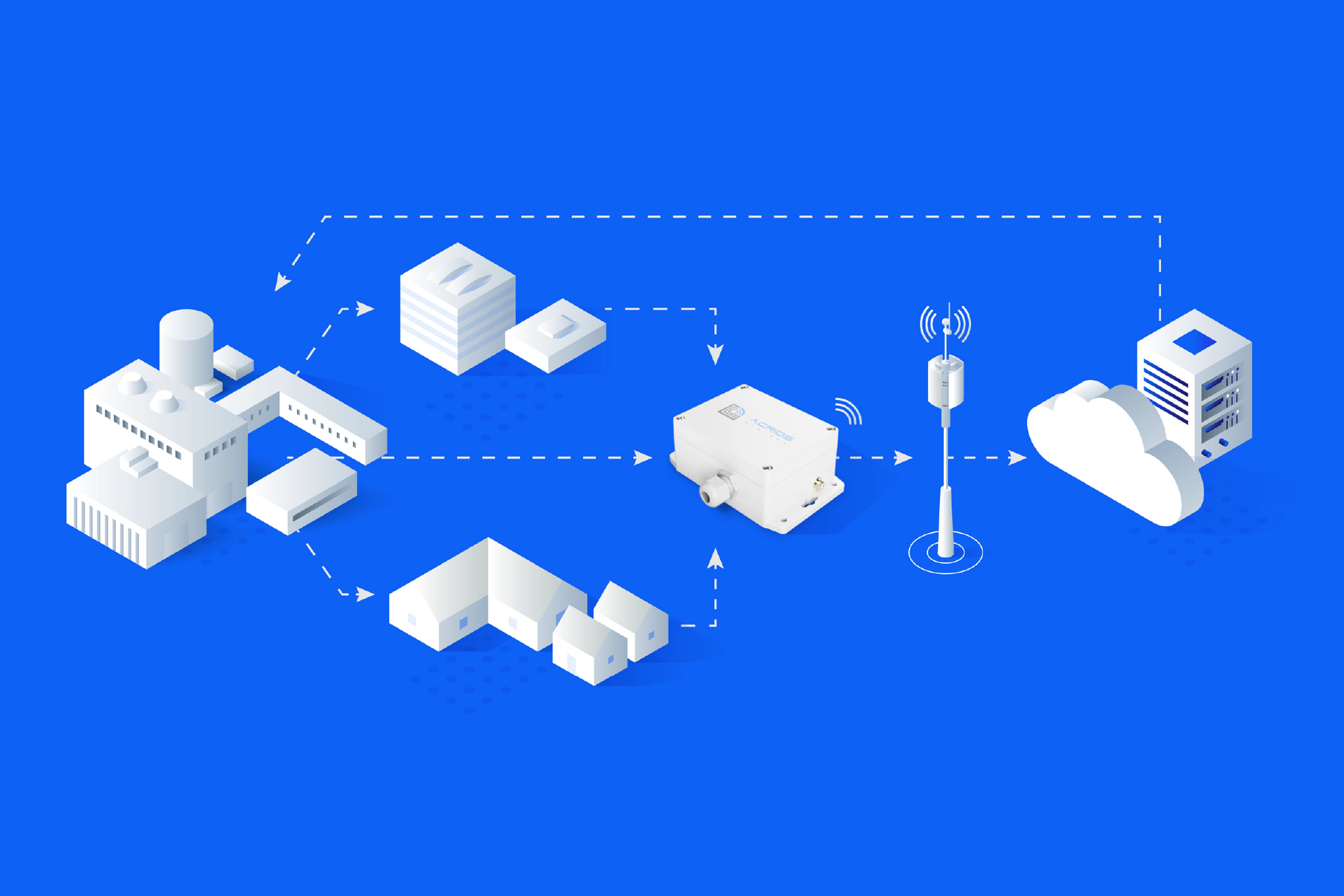
LoRaWAN provides a useful concrete example: M-Bus meters → M-Bus-to-LoRaWAN converter → LoRaWAN gateway → Network Server → application.
The converter communicates with the M-Bus meters and makes their data available over LoRaWAN. The LoRaWAN gateway receives radio packets from LoRaWAN end devices and forwards them towards the Network Server over an IP connection. It does not need to interpret the application payload contained in those packets.
NB-IoT uses a different architecture: M-Bus meters → M-Bus-to-NB-IoT converter → mobile network → application.
There is no equivalent local LoRaWAN-style gateway in this path. The NB-IoT device communicates through the cellular network infrastructure.
This is why asking for an 'IoT gateway' alone is often not enough to specify what a project actually requires. The role of the device within the complete communication architecture matters more than the generic product category.
Concentrator, collector and data logger
Some terms describe what happens to the data rather than how two communication environments are connected. A concentrator or collector gathers data from multiple endpoints into one place and may then process, store or forward it.
A data logger records data locally so that measurements remain available for later retrieval or transmission. These functions are not mutually exclusive. A converter that periodically reads several meters and stores the readings locally is still a converter, but it also performs a data-logging function.
Antenna: part of the radio system, not a data-processing device
An antenna transmits and receives electromagnetic waves used by radio communication systems. It does not parse meter data, translate protocols, store readings or decide where the data should go.
Antenna type, placement and frequency can nevertheless have a direct impact on radio performance. A poorly matched antenna can undermine an otherwise well-designed system. An antenna is therefore a component of the radio system, not an alternative to a converter, bridge or gateway.
Why the terminology never settled
Much of this vocabulary comes from telecommunications and computer networking, where terms such as bridge, gateway and repeater have established technical meanings.
Industrial communication and IoT reused the same vocabulary across field buses, serial interfaces, radio networks and cellular connectivity, and manufacturers often emphasise whichever function matters most for their product.
That does not make the terminology meaningless. It means the label alone is not enough to determine a device's actual role.
Four questions instead of arguing about labels
When two products carry different names for what looks like the same job, four questions are usually more useful than debating what the enclosure should be called.
- What comes in? M-Bus, wM-Bus, RS-485, pulse, 4 to 20 mA or something else?
- What happens inside? Is the communication forwarded or retransmitted? Are readings converted, parsed, filtered or stored?
- What comes out? M-Bus, LoRaWAN, NB-IoT, Ethernet or another interface or network?
- What infrastructure comes next? Does the device communicate through a cellular network, require a LoRaWAN gateway or connect to another local system?
Once these questions are answered, the product name matters far less than whether the device fits the actual communication architecture.
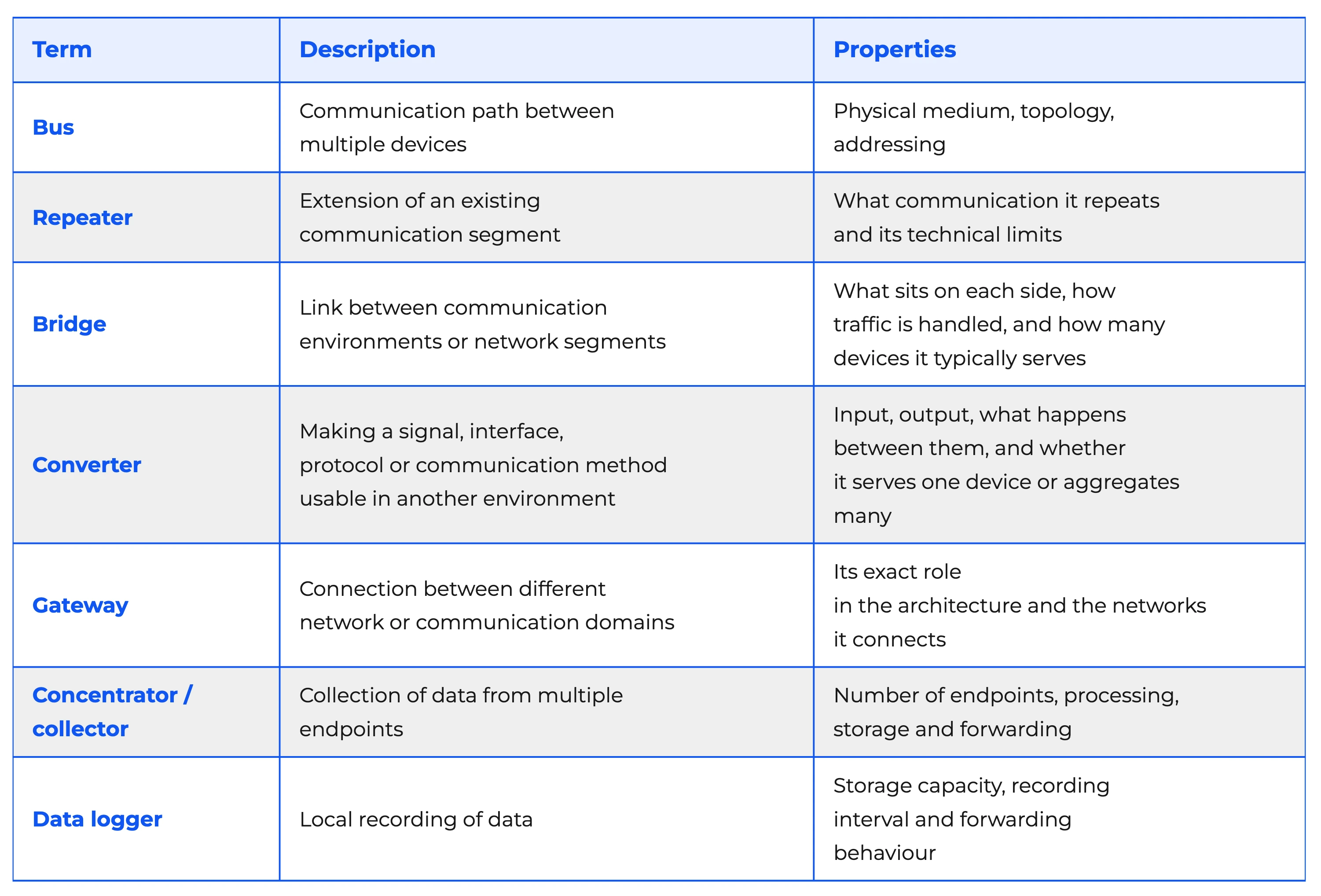
Terminology overview
FAQs
Datasheets rarely make it obvious which category, converter, bridge or gateway, actually fits a specific meter and reach requirement. We at ACRIOS review the installation and points to the connection that fits, not just the one with the closest-sounding name.

Blog

Pulsed water meter: All you need to know
LoRaWAN airtime: why radio conditions matter
What actually drains an IoT device battery
M-Bus parsing strategies for LoRaWAN and NB-IoT

How to best replace walk-by meter reading
Can your existing meters be retrofitted?

Battery life in IoT: beyond the datasheet number
Agile, Waterfall, or NRE? Choosing a development methodology
Developing adaptive IoT communication under the CRA
Focused supplier or large vendor? Depends on the project

Edge computing in IoT metering
Manufacturer as a technology partner

Why a device without an antenna fails

CE certification for IoT: What RED DA changes

Water losses in utility networks: The hidden cost of leaks
Pressure monitoring in water networks: Early fault detection
M-Bus pressure sensor: Leak detection for water utilities
The cost of measurement data errors and how to prevent them

Smart Readiness Indicator (SRI): All you need to know
M-Bus installation tool Wizard from ACRIOS
Coulomb meter: Everything you need to know
ACR-EX in water utilities: remote reading of pulse water meters

ACRIOS and Quectel announce partnership

External or internal? How custom development works

Proven deployment of 10,000 wM-Bus converters for EED
Choosing a remote reading system for water utilities
Open data interfaces pay off for reporting and integration
15-minute vs daily meter readings frequency explained
Scripting in IoT: Flexibility, sustainability, and protection

Gas meter data to dashboard: ACR-EX meets Datacake
EPBD is coming: what BACS means for your building
When DTLS makes sense. Know before you deploy
Not your keys, not your hardware
868 MHz or 433 MHz? The right choice for your wM-Bus
Everything you need to know, documented. ACRIOS wiki.
End-to-end custom hardware and software development
How to collect energy data to support ISO 50001
Lowering IoT TCO through smart manufacturing
Reading Sensus meters with zero hardware changes

Why 15-minute data matters in district heating

Give me a tool that works. Not a manual.

5 most common myths about remote meter reading

Battery-powered vs wired: What really costs more?

Cyber Resilience Act and IoT hardware
Next-gen meter readings, no replacements needed

Modernising metering infrastructure

M-Bus to IoT integration explained
Understanding TCO: More than just hardware
NB-IoT technology: All you need to know

LoRaWAN: All you need to know

M-Bus, wM-Bus, and RS-485: A technology guide

LoRaWAN vs. NB-IoT: Which technology is right for you?
Smart metering: What it is and why it matters
IoT: Technology that saves time and money