How to best replace walk-by meter reading
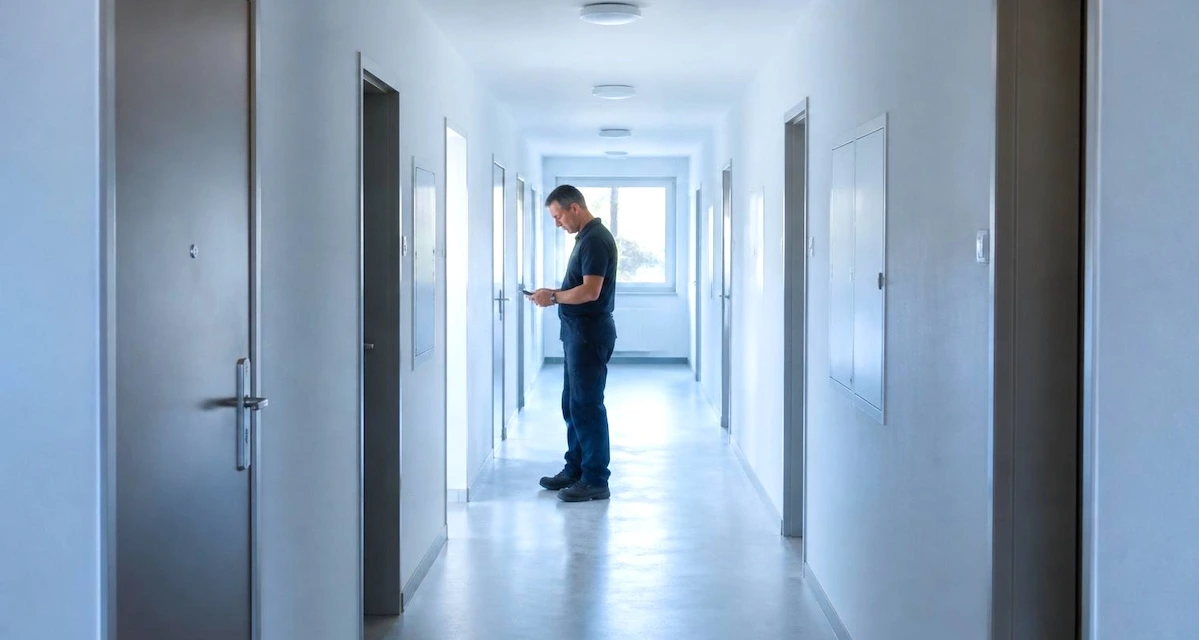
A technician with a laptop and an antenna walks the corridors of an apartment building once or twice a year to catch signals from water and heat meters. That is what walk-by meter reading still looks like in most residential buildings today. When a meter cannot be captured due to shielding, distance, or interference, the technician tries another spot in the corridor, or in the worst case, has to return another day. The result is one or two data points a year, which no longer meets today's expectations.
Key takeaways
- With walk-by reading typically carried out only once or twice a year, administrators get very few consumption data points, while failed readings may require another site visit.
- Moving from walk-by to a fixed network does not necessarily mean replacing the meters. Existing metering infrastructure can often remain in place while the data collection method changes.
- EED requirements are increasing the need for remotely readable meters and more frequent consumption information in buildings, making walk-by increasingly impractical.
- Three approaches are commonly considered: wiring meters to a central point, switching to meters with direct LoRaWAN communication, or keeping existing wM-Bus meters and adding a permanently installed concentrator.
- A wM-Bus concentrator can keep existing wM-Bus meters in service until the end of their calibration period while preserving walk-by reading as a fallback.
- There is no universally best solution. The right approach depends on the existing meters, their remaining service life, and the administrator's objectives.
What is walk-by meter reading?
Walk-by is one of three classic categories of automated meter reading (AMR). Alongside walk-by, there is drive-by, where data is captured by a receiver in a passing vehicle, and fixed network, where receiving infrastructure is permanently installed in the building. Walk-by and drive-by systems have been in use since the 1980s as the first alternative to manual on-site meter reading, and they still operate in a large share of residential buildings today.
Importantly, all three categories, walk-by, drive-by, and fixed network, remain AMR. The meter itself stays the same; only the way its data is collected changes. This differs from AMI (advanced metering infrastructure), which involves installing a new smart meter in place of the existing one. Moving from walk-by to fixed network is therefore a fundamentally different, and cheaper, change than moving to AMI.
The Energy Efficiency Directive (EED) is pushing for more frequent consumption data. It is no longer just about annual billing; it is about an ongoing overview that can flag unusual consumption or a water leak early. EU member states are required to introduce remote meter reading by 2027, which is why building administrators are looking for ways to replace walk-by reading with a fixed network solution. Some assumptions about EED obligations no longer hold. In practice, three approaches are most commonly considered.
Wiring everything to a single point
Meters are connected by cable to a central point in the building, where a concentrator with an internet connection is installed.
- Data transmission is stable, and the building administrator keeps full control.
- Installation in already completed buildings tends to be more complex and expensive.
- Cable routes and work in shared areas need to be planned carefully.
Whether cabling or a battery-powered wireless solution truly pays off depends on more factors than it first appears.
Switching to meters with direct LoRaWAN communication
Meters send data directly to a LoRaWAN network, which then forwards it to the administrator's system.
- Installation is fast, with no need to build in-building infrastructure.
- This tends to suit new installations or a planned meter replacement.
- If a building already has functioning wM-Bus meters installed, moving to LoRaWAN means replacing them, even where they still have a valid calibration.
- Operational demands shift to the network infrastructure: this depends on gateway availability, connectivity, and the service provider.
wM-Bus concentrator: replacing walk-by without replacing meters
The third path is a wM-Bus concentrator, moving straight from walk-by to fixed network without changing the meters.
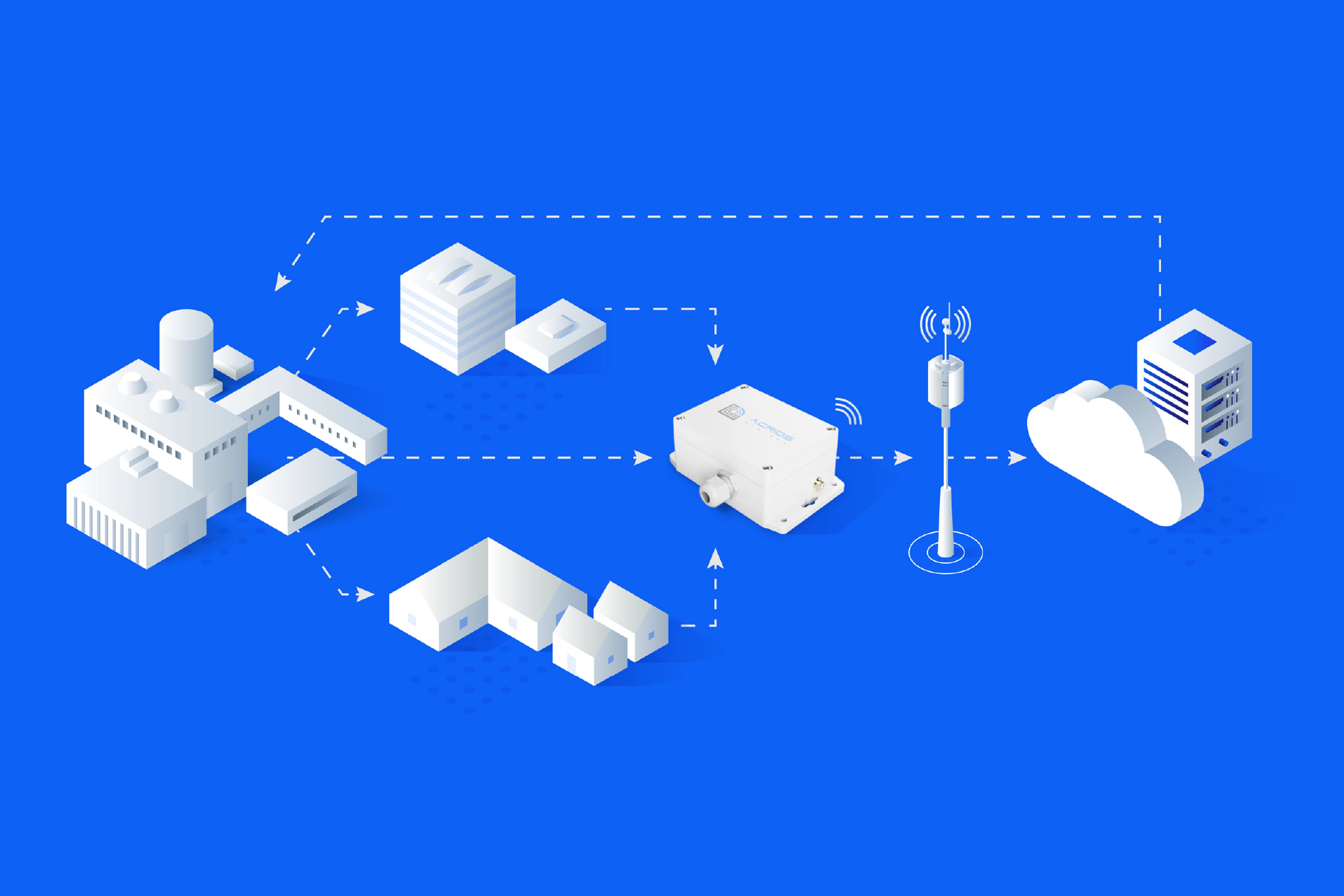
The principle is simple: meters in individual flats keep transmitting exactly as before (wM-Bus), but the building has a permanently installed concentrator that continuously receives the signal, gathers the readings, and sends them over the internet to the administrator's or billing provider's system. The technician's job is not replaced by a better antenna, but by a device permanently present in the building. Advantages of this approach:
- Existing wM-Bus meters continue to be read, so there is no need to replace them to change the reading method.
- Meters can run to the end of their calibration period, and replacement happens naturally and gradually.
- The wM-Bus standard tends to offer a wider range of meters from different manufacturers, making it easier, and often cheaper, to choose a suitable type than with a narrower LoRaWAN portfolio.
- The solution works automatically, but leaves a fallback open: if anything happens to the internet connection or the concentrator, it remains possible, as a last resort, to visit the building with a laptop and antenna and take a walk-by reading, as before.
Comparing the three approaches
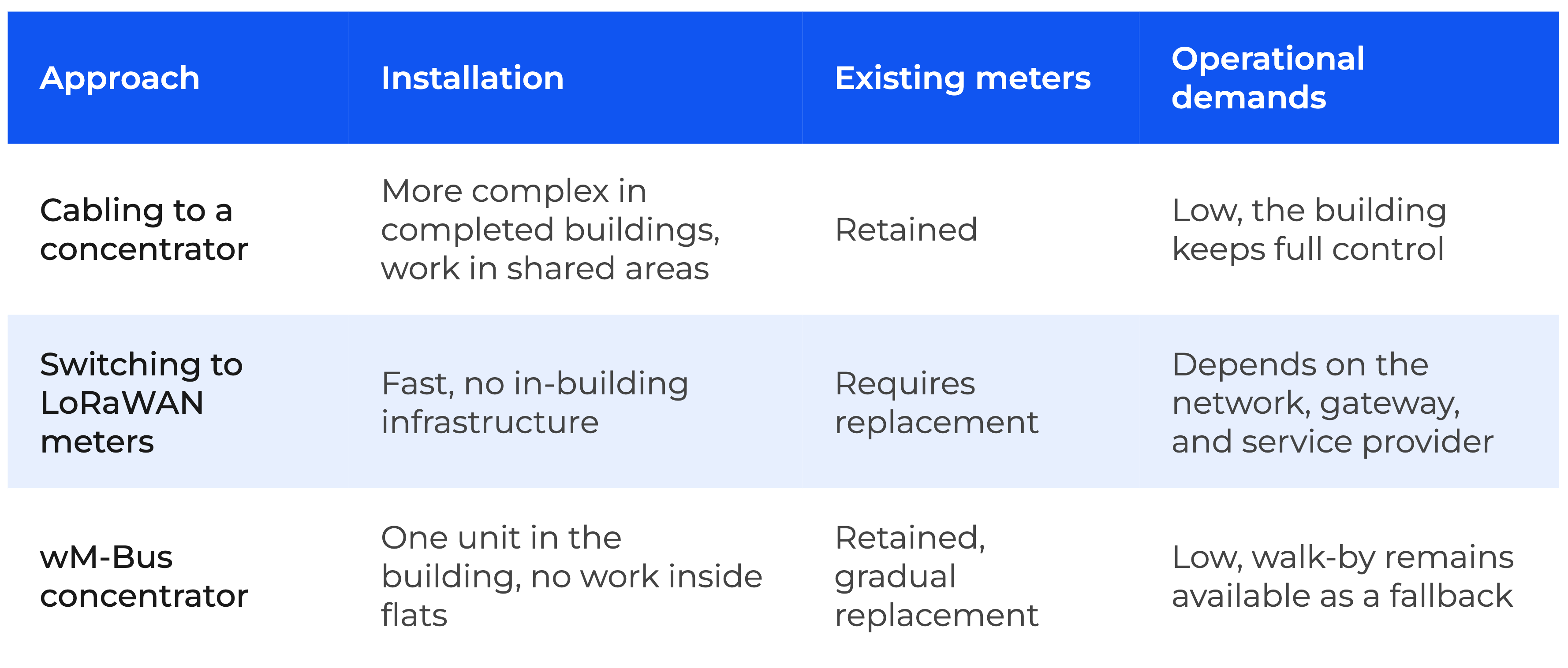
There is no single universally best solution. The right choice depends mainly on what meters are currently installed in the building, how long they will remain in service, and what the administrator is trying to achieve.
In many retrofit projects, though, it makes the most sense to keep functioning meters and modernise only the reading method, moving from walk-by to fixed network with a wM-Bus concentrator, without having to discard working meters or give up walk-by entirely as a fallback.
If you are not sure whether your existing meters are suitable for this step, we cover the topic in more depth in Can your existing meters be retrofitted for remote reading?

Glossary of terms used
- EED (Energy Efficiency Directive) – the EU directive on energy efficiency, which among other things sets requirements for remotely readable meters and regular access to consumption data.
- Walk-by meter reading – a reading method in which a technician regularly visits the building with a receiver to collect data from meters communicating wirelessly. One of three AMR categories, alongside drive-by and fixed network.
- AMR (Automated Meter Reading) and AMI (Advanced Metering Infrastructure) – AMR is the automated collection of data from an existing meter without replacing it. AMI requires installing a new smart meter in place of the existing one.
- Wireless M-Bus (wM-Bus) – a wireless communication standard used to transmit data from water meters, heat meters, and other meters, widely used in residential buildings.
- OMS (Open Metering System) – an open, vendor-independent standard built on wM-Bus, ensuring interoperability between meters from different manufacturers.
- Concentrator – a permanently installed unit that continuously receives data from meters in a building and forwards it over the internet to a central system.
FAQs
No. Most existing meters can be retrofitted using converters that enable remote readings without full replacement of the metering infrastructure.
With walk-by reading, a technician must regularly visit the building and collect data using a portable receiver. Automatic remote reading uses a permanently installed device that gathers data continuously and sends it to the administrator's system automatically, without the need for a site visit.
AMR (automated meter reading) means automated data collection from an existing meter without replacing it. Walk-by reading, moving to fixed network, and a wM-Bus concentrator all fall under AMR. AMI (advanced metering infrastructure), by contrast, requires installing a new smart meter in place of the existing one, which tends to be slower and more costly.
The information is available in the manufacturer's documentation or on the meter itself. Most newer residential water and heat meters are labelled as wireless M-Bus, wM-Bus, or OMS. The specific meter type can also confirm compatibility.
Need help choosing the right solution for your building? We can review the state of your existing meters together and find an option that meets EED requirements without unnecessary cost.

Blog
LoRaWAN airtime: why radio conditions matter
Converter, bus, bridge, gateway: what's the difference?
What actually drains an IoT device battery
M-Bus parsing strategies for LoRaWAN and NB-IoT
Can your existing meters be retrofitted?

Battery life in IoT: beyond the datasheet number
Agile, Waterfall, or NRE? Choosing a development methodology
Developing adaptive IoT communication under the CRA
Focused supplier or large vendor? Depends on the project

Edge computing in IoT metering
Manufacturer as a technology partner

Why a device without an antenna fails

CE certification for IoT: What RED DA changes
Water losses in utility networks: The hidden cost of leaks
Pressure monitoring in water networks: Early fault detection
M-Bus pressure sensor: Leak detection for water utilities
The cost of measurement data errors and how to prevent them

Smart Readiness Indicator (SRI): All you need to know
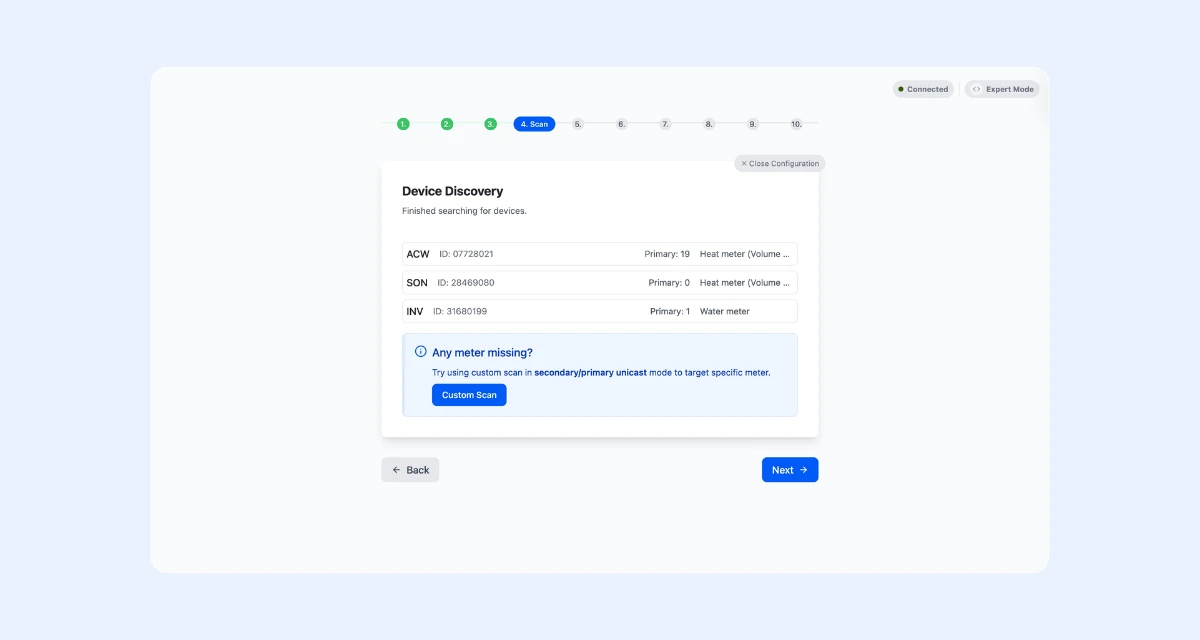
M-Bus installation tool Wizard from ACRIOS
Coulomb meter: Everything you need to know
ACR-EX in water utilities: remote reading of pulse water meters

ACRIOS and Quectel announce partnership

External or internal? How custom development works

Proven deployment of 10,000 wM-Bus converters for EED
Choosing a remote reading system for water utilities
Open data interfaces pay off for reporting and integration

15-minute vs daily meter readings frequency explained
Scripting in IoT: Flexibility, sustainability, and protection

Gas meter data to dashboard: ACR-EX meets Datacake
EPBD is coming: what BACS means for your building
When DTLS makes sense. Know before you deploy
Not your keys, not your hardware
868 MHz or 433 MHz? The right choice for your wM-Bus
Everything you need to know, documented. ACRIOS wiki.
End-to-end custom hardware and software development
How to collect energy data to support ISO 50001

Lowering IoT TCO through smart manufacturing
Reading Sensus meters with zero hardware changes

Why 15-minute data matters in district heating

Give me a tool that works. Not a manual.

5 most common myths about remote meter reading

Battery-powered vs wired: What really costs more?

Cyber Resilience Act and IoT hardware
Next-gen meter readings, no replacements needed

Modernising metering infrastructure

M-Bus to IoT integration explained

Understanding TCO: More than just hardware

NB-IoT technology: All you need to know

LoRaWAN: All you need to know

M-Bus, wM-Bus, and RS-485: A technology guide

LoRaWAN vs. NB-IoT: Which technology is right for you?
Smart metering: What it is and why it matters

IoT: Technology that saves time and money