Battery life in IoT: beyond the datasheet number

What really determines the runtime of battery-powered IoT devices
Key takeaways:
- Battery life in an IoT device is not determined by capacity alone. Temperature, communication method, radio signal quality, and the device's design all play a significant role.
- The lifespan figure on a datasheet is a reference value measured under defined laboratory conditions, not a guaranteed operating time for every installation.
- For primary Li-SOCl₂ batteries, remaining capacity cannot be reliably determined from voltage alone. Load, temperature, and the cell's internal resistance all affect the reading.
- Li-SOCl₂ cells are the standard for long-life IoT devices thanks to their high energy density, low self-discharge and long shelf life.
- A more accurate estimate of battery state requires combining several data points, and in some applications, a coulomb counting method that continuously tracks the actual charge drawn.
- Real battery life is the outcome of the whole device design, from battery selection through electronics and firmware to the communication configuration.
How long does a battery last in an IoT device?
This is one of the most common, and hardest to answer precisely, questions when designing IoT devices for remote meter reading. Manufacturers commonly state a lifespan of ten years or more, but these figures come from precisely defined laboratory conditions and cannot be automatically transferred to every installation.
Two devices using the same battery type can achieve markedly different lifespans in real operation, because capacity alone is not decisive. Operating temperature, communication frequency, radio signal quality, current spikes, power management and the device's own construction all play a significant role, and a single voltage reading cannot reliably show how much capacity remains.
Why voltage does not tell you how much battery remains
With most consumer electronics, we are used to a percentage indicator of remaining capacity. For Li-SOCl₂ cells, this does not work, because they have a very flat discharge curve for most of their life. Voltage stays close to constant for a long time and only drops noticeably near the end of discharge, so two batteries with very different remaining capacity can show almost the same voltage, and the same battery can show different readings under different conditions even though its actual state has barely changed.
The reading is also affected by the size of the current being drawn, ambient temperature, internal resistance and prior operating history. Voltage can dip temporarily under higher load or in cold conditions, then partially recover once the load eases or temperature rises. This is why professional IoT devices usually combine several parameters, such as voltage under load, charge drawn, operating history and temperature, rather than relying on a single reading.
Why Li-SOCl₂ became the standard for long-life IoT devices
Battery-powered IoT devices built for long-term operation, such as converters for remote meter reading, sensors or dataloggers, very often use primary lithium Li-SOCl₂ cells. The reason is a combination of properties that rechargeable batteries cannot offer: very low self-discharge, typically under one per cent of capacity per year, which allows years of storage without significant capacity loss; high energy density, allowing compact devices with long operating life; and a wide operating temperature range, making them suitable for water meter pits, technical rooms and outdoor installations exposed to both frost and summer heat. This combination is why they are the standard for maintenance-free, multi-year operation, though not a universal fit for every application.
Long life does not mean simple behaviour
Li-SOCl₂ cells have one often-overlooked property. During long storage or very low current draw, a passivation layer forms on the lithium anode. This is a natural, expected part of the cell's chemistry, not a sign of ageing or a fault, and it is what gives the cell its very low self-discharge and long shelf life.
It also increases internal resistance, so when a device moves from a long idle period into a short burst of high current draw, for example connecting over NB-IoT or LoRaWAN, voltage can dip temporarily. This does not mean the battery is nearly flat: once the spike passes, voltage typically recovers and the cell keeps operating normally. This is exactly why a Li-SOCl₂ battery's state cannot be judged from a single voltage reading.
Internal resistance: a parameter more important than capacity alone
Battery assessments tend to focus on capacity in ampere-hours, but internal resistance is often just as important for long-term IoT operation. It is what causes voltage to drop under current draw, and the higher the instantaneous draw, the larger the drop. A new cell has low resistance and copes easily with short spikes; as the cell ages, or as temperature changes or passivation develops, resistance rises.
This can cause a device that runs fine under everyday conditions to briefly drop below its electronics' minimum voltage during radio transmission, restarting or reporting the battery as flat even though significant capacity remains. Device design should therefore assess not just rated capacity, but the cell's ability to reliably deliver the current spikes a given application requires.
What really determines battery life in an IoT device
A battery manufacturer can describe their cell precisely, but cannot determine in advance how long it will power a specific device. Real lifespan is a system outcome, from electronics through firmware to actual operating conditions, which is why two devices with the same battery can end up with very different lifespans:
- Temperature
- Cold slows the chemical reactions, raises internal resistance, and increases the voltage drop under load, so a cold battery can appear nearly flat while still holding real capacity; it often recovers once warmed.
- Heat
- Heat has the opposite effect on resistance and capacity use but speeds up ageing and self-discharge, so sustained high temperatures are not ideal either.
- Communication versus measurement
- In most IoT devices, communication, not measurement, is the most energy-intensive activity. A device can spend most of its time in deep sleep drawing very little current, then jump consumption by several orders of magnitude when transmitting. How often it communicates, how much data, how long connections take to establish, and how many retries are needed all matter, and more frequent communication always trades off against battery life.
- Communication technology and configuration
- LoRaWAN, NB-IoT and LTE-M are often compared as if one is inherently more efficient, but coverage quality, transmit power, data size, communication frequency and configuration usually matter more than the technology label itself. A well-configured NB-IoT device can run for years; a poorly configured one on any technology can drain fast.
- Radio signal quality
- Good coverage means a device connects and transmits quickly. Weak signal means repeated connection attempts or longer transmissions, keeping the radio active longer and raising consumption, so the same device can have a very different lifespan depending on whether it sits in a technical room, an underground pit, or deep inside reinforced concrete.
- Current spikes versus average draw
- Many devices sit in very low power mode most of the time and only briefly draw much higher current during communication or processing. These spikes stress the battery far more than average draw does, especially combined with cold or higher internal resistance, so design needs to account for peak draw, not just the average.
- Device-to-device variation
- Two seemingly identical devices, same battery, firmware and technology, can need replacement years apart, because small differences in temperature, communication frequency or signal strength each add up over years of operation.
This is why battery life is never a single number valid for every installation, only an estimate tied to the specific application and conditions.
Why a datasheet does not mean exactly ten years of runtime
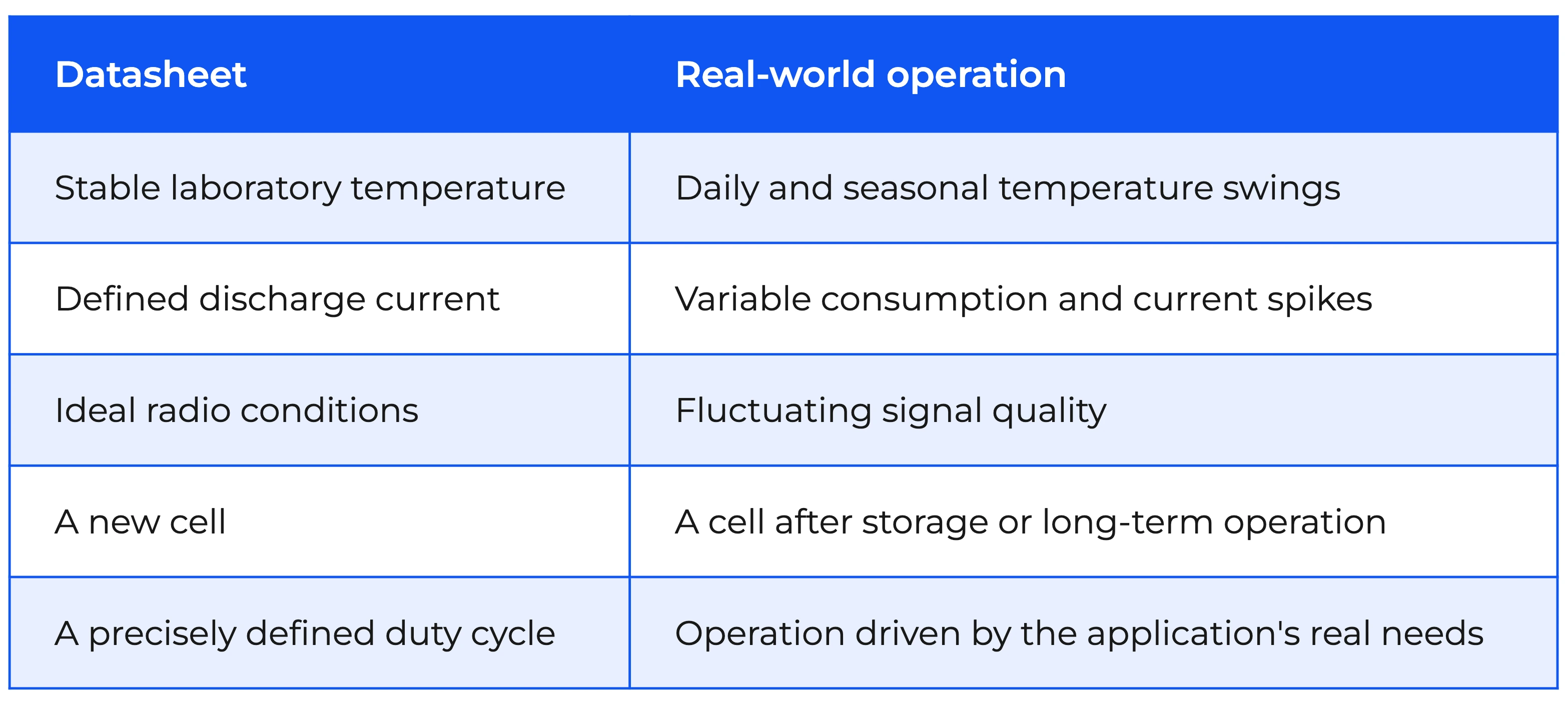
A common mistake is assuming the lifespan on a datasheet is what a battery will reliably deliver in every application. In reality, a datasheet is a technical reference document: it states parameters measured under precisely defined conditions so cells can be compared with one another, not a guarantee for a specific installation.
A stated ten-year lifespan was reached under a predefined combination of temperature, discharge current, load pattern and end voltage, and changing any of these can change the real-world result. Each of these differences can affect energy consumption, and when several combine at once, their impact accumulates over years of operation.
How battery state is estimated in practice
Because voltage alone is not reliable, IoT device manufacturers combine methods depending on the accuracy needed, the battery type and the cost of the design:
- Voltage tracking. The simplest method, low hardware demand, gives a rough indication in some applications, but is affected by temperature, load, internal resistance and chemistry, so it works best as one input among several rather than the sole indicator.
- Coulomb counting. Rather than tracking voltage, this method continuously measures charge drawn and builds a running energy balance, giving a more accurate picture of real consumption, supporting service planning and flagging an approaching end of life. It adds design complexity and cost, so it is used mainly where long-term tracking delivers real value. We cover this in more detail in Coulomb meter: everything you need to know.
- Combined parameters. Professional devices rarely rely on one measurement. Combining rest and load voltage, temperature, draw history, communication cycles, resistance changes and coulomb counter data (where available) produces a model that better reflects a battery's actual behaviour in a specific application.
What this means for IoT device design
Designing a battery-powered IoT device takes more than choosing the highest-capacity cell or following the datasheet lifespan figure. The whole system matters, electronics consumption, firmware and communication approach, and a well-designed device can meaningfully extend battery life by limiting unnecessary transmissions, using low-power modes effectively, and managing radio communication sensibly, while keeping enough energy headroom for low temperatures or poor signal.
This is the difference between a device designed on paper and one that keeps working in the field for years without intervention. When battery, electronics and communication are treated as one system, a ten-year lifespan becomes a realistically achievable target rather than just a datasheet number, much as it does for battery-powered solutions compared with externally powered ones, where reliable long-term runtime is exactly what decides overall running costs.
The values and behaviour described here reflect general properties of Li-SOCl₂ cells and typical IoT applications. Actual runtime always varies with the device chosen, the environment, and the communication setup. We recommend verifying the exact lifespan for your project through testing under real deployment conditions.
Common myths about IoT battery life
- A datasheet guarantees battery lifespan
- REALITY: A datasheet describes results measured under precisely defined conditions. Actual lifespan depends on the specific application, communication method, and operating environment.
- Voltage can precisely show how much battery remains
- REALITY: Voltage is affected by temperature, load, internal resistance, and the cell's chemical properties. A voltage reading alone is not enough to reliably determine remaining capacity.
- A higher battery capacity always means a longer device lifespan
- REALITY: Capacity is only one factor. Electronics consumption, communication interval, radio signal quality, and firmware optimisation matter just as much.
- All li-socl₂ cells behave the same way
- REALITY: Different manufacturers use different construction and production methods. Differences can appear, for example, in how well a cell handles current spikes, in self-discharge, or in long-term stability.
- One communication technology is always more energy-efficient than another
- REALITY: Resulting consumption is shaped mainly by configuration, signal coverage and communication frequency, not simply by the choice between LoRaWAN, NB-IoT and LTE
- A weak signal only affects connection speed, not battery life
- REALITY: A weak signal keeps the radio module active for longer, which directly increases energy consumption.

Glossary of terms used
- Battery capacity: the amount of electrical charge a battery can deliver under defined conditions, typically stated in ampere-hours (Ah). Usable capacity in practice depends on operating conditions, load pattern and ambient temperature.
- Li-SOCl₂ (lithium thionyl chloride): a primary lithium cell using a thionyl chloride-based electrolyte. Thanks to its high energy density, very low self-discharge and wide operating temperature range, it is among the most widely used batteries for long-life IoT devices.
- Energy density: the ratio of stored energy to a battery's volume or weight. Higher energy density allows a device to run for longer without increasing battery size.
- Self-discharge: the natural loss of stored energy in a battery even when it is not connected to any load. In Li-SOCl₂ cells, this is typically very low, usually under 1% of capacity per year, depending on cell construction and storage conditions.
- Passivation: a natural process in which a protective layer forms on the surface of the lithium anode. It limits self-discharge and extends shelf life, but can also temporarily increase the cell's internal resistance and cause a larger voltage drop under higher load.
- Internal resistance: the electrical resistance inside a battery that causes voltage to drop under current draw. Its value changes with the battery's age, temperature, and degree of passivation, and significantly affects the cell's ability to handle short current spikes.
- Current spike: a brief draw of significantly higher current, for example during radio communication or data transmission. Current spikes are one of the main factors affecting battery life in IoT devices.
- State of charge (SoC): an estimate of a battery's remaining capacity, usually expressed as a percentage. For primary Li-SOCl₂ cells, SoC cannot be reliably determined from an instantaneous voltage reading alone, as it is affected by several other factors.
- Coulomb counting: a method of estimating battery state based on continuously measuring the electrical charge drawn from the cell. It provides a more accurate estimate of remaining capacity than voltage alone, and is used mainly in applications where tracking a device's long-term energy balance matters.
- Datasheet: manufacturer's technical document containing parameters measured under precisely defined conditions. It serves as a reference for device design and for comparing individual cells, not as a guarantee of actual lifespan in a specific application.
FAQs
Want to get the power design right for your IoT project? Get in touch, and we will help you find a solution that extends battery life and lowers your total running costs.

Blog

Pulsed water meter: All you need to know
Converter, bus, bridge, gateway: what's the difference?
LoRaWAN airtime: why radio conditions matter
What actually drains an IoT device battery
M-Bus parsing strategies for LoRaWAN and NB-IoT

How to best replace walk-by meter reading

Can your existing meters be retrofitted?
Agile, Waterfall, or NRE? Choosing a development methodology

Developing adaptive IoT communication under the CRA

Focused supplier or large vendor? Depends on the project

Edge computing in IoT metering
Manufacturer as a technology partner

Why a device without an antenna fails

CE certification for IoT: What RED DA changes

Water losses in utility networks: The hidden cost of leaks
Pressure monitoring in water networks: Early fault detection
M-Bus pressure sensor: Leak detection for water utilities
The cost of measurement data errors and how to prevent them

Smart Readiness Indicator (SRI): All you need to know
M-Bus installation tool Wizard from ACRIOS
Coulomb meter: Everything you need to know
ACR-EX in water utilities: remote reading of pulse water meters

ACRIOS and Quectel announce partnership

External or internal? How custom development works

Proven deployment of 10,000 wM-Bus converters for EED
Choosing a remote reading system for water utilities
Open data interfaces pay off for reporting and integration

15-minute vs daily meter readings frequency explained
Scripting in IoT: Flexibility, sustainability, and protection

Gas meter data to dashboard: ACR-EX meets Datacake
EPBD is coming: what BACS means for your building
When DTLS makes sense. Know before you deploy

Not your keys, not your hardware
868 MHz or 433 MHz? The right choice for your wM-Bus
Everything you need to know, documented. ACRIOS wiki.
End-to-end custom hardware and software development
How to collect energy data to support ISO 50001

Lowering IoT TCO through smart manufacturing
Reading Sensus meters with zero hardware changes

Why 15-minute data matters in district heating

Give me a tool that works. Not a manual.

5 most common myths about remote meter reading

Battery-powered vs wired: What really costs more?

Cyber Resilience Act and IoT hardware
Next-gen meter readings, no replacements needed

Modernising metering infrastructure

M-Bus to IoT integration explained

Understanding TCO: More than just hardware

NB-IoT technology: All you need to know

LoRaWAN: All you need to know

M-Bus, wM-Bus, and RS-485: A technology guide

LoRaWAN vs. NB-IoT: Which technology is right for you?
Smart metering: What it is and why it matters

IoT: Technology that saves time and money